Mostrando postagens com marcador VERBS. Mostrar todas as postagens

Passive VOICE

 The Passive Voice: Important Rules and Examples 

In active voice, the subject performs the action of the verb. In passive voice, the subject receives the action of the verb. If you feel like you need a little more than that, keep reading.


What is passive voice?


The subject of a sentence is the person or thing that sentence is about.

The passive voice is when an action happens to the subject.

In terms of format, passive voice generally combines a form of the verb to be with a past tense verb. In the sentence “Peter Parker was bitten,” for example, the to be verb is was and the past tense verb is bitten. The action (bite) is being performed upon the subject (Peter Parker), so this sentence is written in the passive voice.

Most sentences written in passive voice feature an agent that’s performing the action. For example, the above sentence could also be written as “Peter Parker was bitten by a spider.” Here, the agent (a spider) is performing the action on Peter.


Active Voice


In active voice, the subject itself performs the action rather than having the action performed upon it.

So you can think of this subject as actively doing things. For example, “The spider bit Peter Parker.” The spider is now the subject of the sentence, and performs the main action (bit) on Peter. So this sentence is written in active voice.

In active voice, the object of the sentence (typically a noun that receives the action) comes directly after the verb. Here, the object is Peter. (Sentences written in active voice don’t always need an object.)


Changing passive voice to active voice


To change passive voice to active voice, make the agent of the sentence into the subject, and turn the old subject into the object.

For example, this is a passive sentence: “The article is being read by most of my class.” The agent is most of my class, and the subject is the article.

Written in the active voice, this sentence would be “Most of my class is reading the article.” Here, the new subject is most of my class and the object is the article.


Advantages of passive and active voice


Active voice tends to sound more direct in tone because the subject leads the sentence. Asking “Why didn’t you answer your phone?” sounds more direct and authoritative than “Why wasn’t your phone answered by you?” It also makes the sentence sound much more clear.

Passive voice works well in instances when the agent is unclear, or when you want to de-emphasize the agent. It’s frequently used in scientific writing to neutralize perspective. This is particularly helpful when describing a specific process, as in “The flask was filled with a transparent solution.”


Passive Voice

What is the passive voice?


In general we tend to use the active voice. That is when a subject does an action to an object.

  1. Somebody stole my laptop. (subject = Somebody / action(verb) = stole / object = my laptop)

he passive voice is used when we want to emphasize the action (the verb) and the object of a sentence rather than subject. This means that the subject is either less important than the action itself or that we don’t know who or what the subject is.

  1. My laptop was stolen. (The object – now the subject = My laptop / action= was stolen)
  1. Passive: Napa Valley is known for its excellent wines.
  2. Active: [Many people] know Napa Valley for its excellent wines.
  3. Passive: Twenty civilians were killed in the bomb explosion.
  4. Active: Someone killed twenty civilians in the bomb explosion.


The passive agent


When we know who the subject is, we put it at the end with by. We call this an agent.

  1. Passive: The Mona Lisa was painted by Leonardo Da Vinci. (agent =Leonardo Da Vinci )
  2. Active: Leonaro Da Vinci painted the Mona Lisa.

Most writing instructors and editors recommend against using the passive voice, when possible. The reason for this is that when you use the active voice, your writing is clearer and less complicated.

  1. Active: While Mr. Taylor was driving down Highway 101, a police officer pulled him over and gave him a speeding ticket.
  2. Passive: While Mr. Taylor was driving down Highway 101, he was pulled over and given a ticket by a police officer.

If it’s a long sentence and you know who the subject is, it’s best to use the active voice.

The passive is often used to report something or to state a fact.

  1. Highway 15 was closed yesterday due to a serious road accident.
  2. A lot of corn is grown in Iowa.


Forming the passive voice


The passive voice is not a tense in English. Each tense has its own passive voice which is created by using a form of the auxiliary verb to be + V3 (past participle)

The passive voice in each tense:


Tense Auxiliary verb + sample V3 (past participle) Examples
Present simple am, is, are + made Wine is made from grapes.
Many cars are made in Japan.
Present progressive am, is, are + being + sent The document is being sent right now.
I am being sent to work in the London office.
Past simple was, were + invited John was invited to speak at the conference.
We were invited to Daniel and Mary’s wedding.
Past progressive was, were + being + washed The dog was being washed when I got home.
Their cars were being washed while they were in the mall shopping.
Future (will) will be + signed The contract will be signed tomorrow.
The documents will all be signed by next week.
Future (going to) am, is, are + going to be + built A bridge is going to be built within the next two years.
New houses are going to be built in our neighborhood.
Present perfect has, have + been + sold That start-up has been sold for $5 million.
The rights to his book have been sold for $250,000.
Past perfect had + been + hired The new manager had been hired before John left the company.
All the employees had hired before the store opened.
Future perfect will + have been + finished The car will have been loaded by the time he gets home.
The crates will have been loaded by then.
Modals: can/could can, could + be + issued A passport can only be issued at the embassy.
He said the documents could be issued within the week.
Modal: have to have to, has to, had to + be + arranged A babysitter has to be arranged for this evening.
Joan’s travel plans have to be arranged by December.
Modal: must must + be + stopped Criminals must be stopped before they commit crimes.


All of the rules for passive negatives and questions are the same as for the active voice.

Note: Verbs that have no object (no one to “receive” the action) cannot be put into the passive, such as, arrive, come, die, exist, go, happen, have, live, occur sleep, etc.

English Tenses


All English Tenses in a Table


English Verb Tenses List


  • Present Simple
  • Present Continuous
  • Present Perfect
  • Present Perfect Continuous
  • Past Simple
  • Past Continuous
  • Past Perfect
  • Past Perfect Continuous
  • Future Simple
  • Future Continuous
  • Future Perfect
  • Future Perfect Continuous


English Tenses


English Verb Tenses

English Verb Tenses

English Verb Tenses

English Verb Tenses


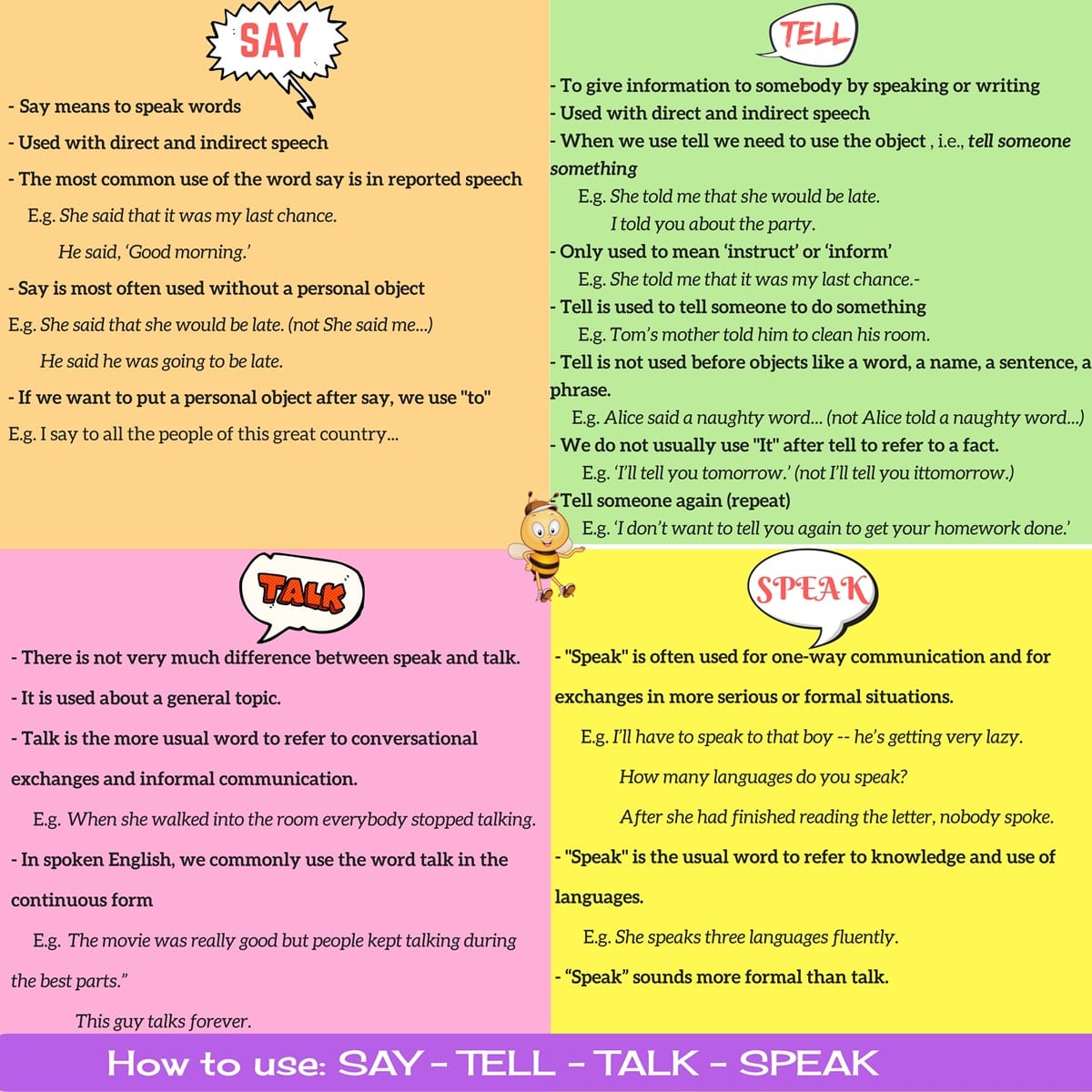
SAY, TALK, TELL and SPEAK


The Difference between SAY, TALK, TELL and SPEAK in English


Difference between SAY, TALK, TELL and SPEAK 


M

Direct and Indirect Speech


Direct and indirect speech can be a source of confusion for English learners. Let's first define the terms, then look at how to talk about what someone said, and how to convert speech from direct to indirect or vice-versa.

You can answer the question What did he say? in two ways:


  • by repeating the words spoken (direct speech)
  • by reporting the words spoken (indirect or reported speech).


Direct Speech


Direct speech repeats, or quotes, the exact words spoken. When we use direct speech in writing, we place the words spoken between quotation marks (" ") and there is no change in these words. We may be reporting something that's being said NOW (for example a telephone conversation), or telling someone later about a previous conversation.


Examples


  • She says, "What time will you be home?"
  • She said, "What time will you be home?" and I said, "I don't know! "
  • "There's a fly in my soup!" screamed Simone.
  • John said, "There's an elephant outside the window."


Indirect Speech


Reported or indirect speech is usually used to talk about the past, so we normally change the tense of the words spoken. We use reporting verbs like 'say', 'tell', 'ask', and we may use the word 'that' to introduce the reported words. Inverted commas are not used.

She said, "I saw him." (direct speech) = She said that she had seen him. (indirect speech)

'That' may be omitted:


She told him that she was happy. = She told him she was happy.


'Say' and 'tell'


Use 'say' when there is no indirect object:
He said that he was tired.

Always use 'tell' when you say who was being spoken to (i.e. with an indirect object):
He told me that he was tired.


'Talk' and 'speak'


Use these verbs to describe the action of communicating:
He talked to us.
She was speaking on the telephone.

Use these verbs with 'about' to refer to what was said:
He talked (to us) about his parents.

JJJJ

Grammar: Present Time And Stative Verbs


Present Simple 

The present tense is the base form of the word.

➮I walk
➮You sing
➮We run
➮He cuts
➮She loves
➮It comes
➮We look
➮They sleep

Present Progressive

The present continuous is made from the present tense of the verb be and the –ing form of a verb:

➮I am sleeping
➮You are talking
➮He is running
➮She is sitting
➮It is coming
➮We are looking
➮They are leaving


Stative Verbs

They express a state -not an action- and are not used in Progressive Tenses.

Verb of the senses:
feel, hear, see, smell, taste, notice, etc.

Wrong:I am hearing you.
Correct:I hear you.

Verbs of emotions and preferences:
like, dislike, love, hate, fear, mind, want, wish, need, prefer, admite, etc.

Wrong: I am wanting it.
Correct: I want it.


Verbs of perception, belief, knowledge, ownership:
think, believe, know, understand, expect, remember, forget, hope, have, own, belong (to), etc.

Wrong: I am remembering your name.
Correct: I remember your name.

Other verbs which describe permanent states:
be,cost

REMEMBER

Some stative verbs can be used in the progressive forms when they express actions rather than states, but with a difference in meaning.

State: They have a wonderful house.
Action: I am having a bath.

State: I see Mary coming towards us.
Action: I am seeing the doctor tomorrow.

State: I think she is clever.
Action: I am thinking of buying a new car.

State: Do I smell smoke?
Action: Why are you smelling the milk? Do you think it is gone off?

State: He is very selfish. (that is his character)
Action: Why is he being selfish? (why is he behaving so selfishly?)

Listenlook and watch, though verbs of the senses, can also be used in the progressive tenses because they express voluntary actions.

, weigh, seem, appear, consist (of), etc. 


James is watching the new.
She is looking our way.
I am listening to you.

Stative Verbs

Stative, or non action verbs do not express action.  They express a state or condition, and usually only occur in the Present Simple.  When they do occur in the Present Progressive, there is often a difference in meaning.

Some common stative verbs are:

Attitudes and Emotions

  • love, like, hate, dislike, fear
  • want, need, prefer, appreciate
  • doubt, wish, care, mind, promise, deny, concern

Belief and Knowledge

  • believe, know, think, feel (= opinion), hope, doubt, imagine
  • mean, understand, realize, suppose, guess
  • remember, forget, agree, disagree

Descriptions and measurements

  • be, appear, look (= seem), look like, seem, resemble
  • sound, sound like
  • weigh (have weight), measure (have length), cost
  • fit, contain

Possession and Relationships

  • have, own, possess
  • owe, belong, depend on
  • include, contain, consist of

Senses

  • see, hear, smell, taste, feel
  • ache, hurt, burn, itch, sting

 He owes me money.      ✘ He’s owing me money.

 They seem happy.         ✘ They are seeming happy.

 I forget his name.           ✘ I’m forgetting his name.

 She knows the answer.  ✘ She is knowing the answer.

.

Some verbs can be both stative and active, with a difference in meaning.

Present Simple (stative)                                                     Present Progressive (active)

I think this is delicious (belief)                 We’re thinking about moving (mental activity)

It weighs a lot (measurement)                   I’m weighing it on the scale (physical activity)

She has six cats (possession)                                        She’s having a bad time (experience)

He has a nice house (possession)                        He’s having lunch with Jennifer (eating)

This soup tastes great (it has a certain flavour)       The chef is tasting the soup (action)

I smell something gross (it has a certain smell)           I’m smelling each flower (action)

I see him (he’s over there)                                    I’m seeing him (I’m dating / meeting him)

.

The “be” verb is usually stative, but when it’s used in the continuous it suggests temporary, or atypical behaviour.

Present Simple (stative)                                                     Present Progressive (active)

My kids are good. (they’re always good)  My kids are being good! (usually they are bad)

You are stupid (it’s part of your personality)                      You are being stupid (only now)

He wears nice clothes (all the time)                       He’s wearing nice clothes (only today)


Passive VOICE


In active voice, the subject performs the action of the verb. In passive voice, the subject receives the action of the verb. If you feel like you need a little more than that, keep reading.

What is passive voice?

The subject of a sentence is the person or thing that sentence is about.

The passive voice is when an action happens to the subject.

In terms of format, passive voice generally combines a form of the verb to be with a past tense verb. In the sentence “Peter Parker was bitten,” for example, the to be verb is was and the past tense verb is bitten. The action (bite) is being performed upon the subject (Peter Parker), so this sentence is written in the passive voice.

Most sentences written in passive voice feature an agent that’s performing the action. For example, the above sentence could also be written as “Peter Parker was bitten by a spider.” Here, the agent (a spider) is performing the action on Peter.

Active Voice

In active voice, the subject itself performs the action rather than having the action performed upon it.

So you can think of this subject as actively doing things. For example, “The spider bit Peter Parker.” The spider is now the subject of the sentence, and performs the main action (bit) on Peter. So this sentence is written in active voice.

In active voice, the object of the sentence (typically a noun that receives the action) comes directly after the verb. Here, the object is Peter. (Sentences written in active voice don’t always need an object.)

Changing passive voice to active voice

To change passive voice to active voice, make the agent of the sentence into the subject, and turn the old subject into the object.

For example, this is a passive sentence: “The article is being read by most of my class.” The agent is most of my class, and the subject is the article.

Written in the active voice, this sentence would be “Most of my class is reading the article.” Here, the new subject is most of my class and the object is the article.

Advantages of passive and active voice

Active voice tends to sound more direct in tone because the subject leads the sentence. Asking “Why didn’t you answer your phone?” sounds more direct and authoritative than “Why wasn’t your phone answered by you?” It also makes the sentence sound much more clear.

Passive voice works well in instances when the agent is unclear, or when you want to de-emphasize the agent. It’s frequently used in scientific writing to neutralize perspective. This is particularly helpful when describing a specific process, as in “The flask was filled with a transparent solution.”


Passive Voice

What is the passive voice?


In general we tend to use the active voice. That is when a subject does an action to an object.

  1. Somebody stole my laptop. (subject = Somebody / action(verb) = stole / object = my laptop)

he passive voice is used when we want to emphasize the action (the verb) and the object of a sentence rather than subject. This means that the subject is either less important than the action itself or that we don’t know who or what the subject is.

  1. My laptop was stolen. (The object – now the subject = My laptop / action= was stolen)
  1. Passive: Napa Valley is known for its excellent wines.
  2. Active: [Many people] know Napa Valley for its excellent wines.
  3. Passive: Twenty civilians were killed in the bomb explosion.
  4. Active: Someone killed twenty civilians in the bomb explosion.

The passive agent

When we know who the subject is, we put it at the end with by. We call this an agent.

  1. Passive: The Mona Lisa was painted by Leonardo Da Vinci. (agent =Leonardo Da Vinci )
  2. Active: Leonaro Da Vinci painted the Mona Lisa.

Most writing instructors and editors recommend against using the passive voice, when possible. The reason for this is that when you use the active voice, your writing is clearer and less complicated.

  1. Active: While Mr. Taylor was driving down Highway 101, a police officer pulled him over and gave him a speeding ticket.
  2. Passive: While Mr. Taylor was driving down Highway 101, he was pulled over and given a ticket by a police officer.

If it’s a long sentence and you know who the subject is, it’s best to use the active voice.

The passive is often used to report something or to state a fact.

  1. Highway 15 was closed yesterday due to a serious road accident.
  2. A lot of corn is grown in Iowa.

Forming the passive voice

The passive voice is not a tense in English. Each tense has its own passive voice which is created by using a form of the auxiliary verb to be + V3 (past participle)


The passive voice in each tense:


Tense Auxiliary verb + sample V3 (past participle) Examples
Present simple am, is, are + made Wine is made from grapes.
Many cars are made in Japan.
Present progressive am, is, are + being + sent The document is being sent right now.
I am being sent to work in the London office.
Past simple was, were + invited John was invited to speak at the conference.
We were invited to Daniel and Mary’s wedding.
Past progressive was, were + being + washed The dog was being washed when I got home.
Their cars were being washed while they were in the mall shopping.
Future (will) will be + signed The contract will be signed tomorrow.
The documents will all be signed by next week.
Future (going to) am, is, are + going to be + built A bridge is going to be built within the next two years.
New houses are going to be built in our neighborhood.
Present perfect has, have + been + sold That start-up has been sold for $5 million.
The rights to his book have been sold for $250,000.
Past perfect had + been + hired The new manager had been hired before John left the company.
All the employees had hired before the store opened.
Future perfect will + have been + finished The car will have been loaded by the time he gets home.
The crates will have been loaded by then.
Modals: can/could can, could + be + issued A passport can only be issued at the embassy.
He said the documents could be issued within the week.
Modal: have to have to, has to, had to + be + arranged A babysitter has to be arranged for this evening.
Joan’s travel plans have to be arranged by December.
Modal: must must + be + stopped Criminals must be stopped before they commit crimes.

All of the rules for passive negatives and questions are the same as for the active voice.

Note: Verbs that have no object (no one to “receive” the action) cannot be put into the passive, such as, arrive, come, die, exist, go, happen, have, live, occur sleep, etc.