Mostrando postagens com marcador ENGLISH GRAMMAR. Mostrar todas as postagens

8 Parts of Speech with Meaning and Examples

 Parts of Speech: Definition, (8)Types, Examples 

8 Parts of Speech in English


NOUN

  • A noun names a person, place, things or idea.
  • Examples: pen, house, book, teacher, students, daughter, thief, Mary, and etc.
  • Example Sentence: The teacher gives us a lot of homework.


ADVERB

  • An adverb tells how often, how, when, where. It can describe a verb, an adjective or an adverb.
  • Examples: frequently, seldom, sometimes, early, soon, etc.
  • Example Sentence: Don’t worry, he will get well soon!


VERB

  • A verb is a word or group of words that describes an action, experience.
  • Examples: study, think, prepare, realize, believe, look, see and etc.
  • Example Sentence: Jim studies hard to pass the final exam.


ADJECTIVE

  • An adjective describes a noun or pronoun.
  • Examples: tall, thin, red, beautiful, ugly, sweet, handsome and etc.
  • Example Sentence: You look so beautiful in that red dress.


PREPOSITION

  • A preposition is used before a noun, pronoun, or gerund to show place, time, direction in a sentence.
  • Examples: at, in, on, from, above, below etc.
  • Example Sentence: Be careful! the cat is lying under your table.


CONJUNCTION

  • Conjunctions join words or groups of words in a sentence.
  • Examples: so, until, and, because, yet, therefore, moreover, since, or,  but and etc.
  • Example Sentence: I have studied English since 1995.


PRONOUN

  • Pronouns replace the name of a person, place, thing or idea in a sentence.
  • Examples: this, that, he, she, it, we, they, him, her, and etc.
  • Example Sentence: This book belongs to her friend.


INTERJECTION

  • Interjections express strong emotion and are often followed by an exclamation point.
  • Examples: Hooray! Yeah! Oops! Phew! Bravo! Well! Aha!
  • Example Sentence: Yeah! Finally, I passed this exam!


THE EIGHT PARTS OF SPEECH


There are eight parts of speech in the English language: noun, pronoun, verb, adjective, adverb, preposition, conjunction, and interjection. The part of speech indicates how the word functions in meaning as well as grammatically within the sentence. An individual word can function as more than one part of speech when used in different circumstances. Understanding parts of speech is essential for determining the correct definition of a word when using the dictionary.


1. NOUN

  • A noun is the name of a person, place, thing, or idea.

man... Butte College... house... happiness

A noun is a word for a person, place, thing, or idea. Nouns are often used with an article (the, a, an), but not always. Proper nouns always start with a capital letter; common nouns do not. Nouns can be singular or plural, concrete or abstract. Nouns show possession by adding 's. Nouns can function in different roles within a sentence; for example, a noun can be a subject, direct object, indirect object, subject complement, or object of a preposition.

The young girl brought me a very long letter from the teacher, and then she quickly disappeared. Oh my!

See the TIP Sheet on "Nouns" for further information.


2. PRONOUN

  • A pronoun is a word used in place of a noun.

She... we... they... it

A pronoun is a word used in place of a noun. A pronoun is usually substituted for a specific noun, which is called its antecedent. In the sentence above, the antecedent for the pronoun she is the girl. Pronouns are further defined by type: personal pronouns refer to specific persons or things; possessive pronouns indicate ownership; reflexive pronouns are used to emphasize another noun or pronoun; relative pronouns introduce a subordinate clause; and demonstrative pronouns identify, point to, or refer to nouns.

The young girl brought me a very long letter from the teacher, and then she quickly disappeared. Oh my!

See the TIP Sheet on "Pronouns" for further information.


3. VERB

  • A verb expresses action or being.

jump... is... write... become

The verb in a sentence expresses action or being. There is a main verb and sometimes one or more helping verbs. ("She can sing." Sing is the main verb; can is the helping verb.) A verb must agree with its subject in number (both are singular or both are plural). Verbs also take different forms to express tense.

The young girl brought me a very long letter from the teacher, and then she quickly disappeared. Oh my!

See the TIP Sheet on "Verbs" for more information.


4. ADJECTIVE

  • An adjective modifies or describes a noun or pronoun.

pretty... old... blue... smart

An adjective is a word used to modify or describe a noun or a pronoun. It usually answers the question of which one, what kind, or how many. (Articles [a, an, the] are usually classified as adjectives.)

The young girl brought me a very long letter from the teacher, and then she quickly disappeared. Oh my!

See the TIP Sheet on "Adjectives" for more information.


5. ADVERB

  • An adverb modifies or describes a verb, an adjective, or another adverb.

gently... extremely... carefully... well

An adverb describes or modifies a verb, an adjective, or another adverb, but never a noun. It usually answers the questions of when, where, how, why, under what conditions, or to what degree. Adverbs often end in -ly.

The young girl brought me a very long letter from the teacher, and then she quickly disappeared. Oh my!

See the TIP Sheet on "Adverbs" for more information.


6. PREPOSITION

  • A preposition is a word placed before a noun or pronoun to form a phrase modifying another word in the sentence.

by... with.... about... until

(by the tree, with our friends, about the book, until tomorrow)

A preposition is a word placed before a noun or pronoun to form a phrase modifying another word in the sentence. Therefore a preposition is always part of a prepositional phrase. The prepositional phrase almost always functions as an adjective or as an adverb. The following list includes the most common prepositions:

The young girl brought me a very long letter from the teacher, and then she quickly disappeared. Oh my!
See the TIP Sheet on "Prepositions" for more information.


7. CONJUNCTION

  • A conjunction joins words, phrases, or clauses.

and... but... or... while... because

A conjunction joins words, phrases, or clauses, and indicates the relationship between the elements joined. Coordinating conjunctions connect grammatically equal elements: and, but, or, nor, for, so, yet. Subordinating conjunctions connect clauses that are not equal: because, although, while, since, etc. There are other types of conjunctions as well.

The young girl brought me a very long letter from the teacher, and then she quickly disappeared. Oh my!

See the TIP Sheet on "Conjunctions" for more information.


8. INTERJECTION

  • An interjection is a word used to express emotion.

Oh!... Wow!... Oops!

An interjection is a word used to express emotion. It is often followed by an exclamation point.

The young girl brought me a very long letter from the teacher, and then she quickly disappeared. Oh my!

Grammar Vocabulary

 Grammar vs Vocab: where to place your focus – Insights to English 

Active voice


In the active voice, the subject of the verb does the action (eg They killed the President). See also Passive Voice.


Adjective


A word like big, red, easy, French etc. An adjective describes a noun or pronoun.


Adverb


A word like slowly, quietly, well, often etc. An adverb modifies a verb.


Article


The "indefinite" articles are a and an. The "definite article" is the.


Auxiliary verb


A verb that is used with a main verb. Be, do and have are auxiliary verbs. Can, may, must etc are modal auxiliary verbs.


Clause


A group of words containing a subject and its verb (for example: It was late when he arrived).


Conjunction


A word used to connect words, phrases and clauses (for example: and, but, if).


Infinitive


The basic form of a verb as in to work or work.


Interjection


An exclamation inserted into an utterance without grammatical connection (for example: oh!, ah!, ouch!, well!).


Modal verb


An auxiliary verb like can, may, must etc that modifies the main verb and expresses possibility, probability etc. It is also called "modal auxiliary verb".


Noun


A word like table, dog, teacher, America etc. A noun is the name of an object, concept, person or place. A "concrete noun" is something you can see or touch like a person or car. An "abstract noun" is something that you cannot see or touch like a decision or happiness. A "countable noun" is something that you can count (for example: bottle, song, dollar). An "uncountable noun" is something that you cannot count (for example: water, music, money).


Object


In the active voice, a noun or its equivalent that receives the action of the verb. In the passive voice, a noun or its equivalent that does the action of the verb.


Participle


The -ing and -ed forms of verbs. The -ing form is called the "present participle". The -ed form is called the "past participle" (for irregular verbs, this is column 3).


Part of speech


One of the eight classes of word in English - noun, verb, adjective, adverb, pronoun, preposition, conjunction and interjection.


Passive voice


In the passive voice, the subject receives the action of the verb (eg The President was killed). See also Active Voice.


Phrase


A group of words not containing a subject and its verb (eg on the table, the girl in a red dress).


Predicate


Each sentence contains (or implies) two parts: a subject and a predicate. The predicate is what is said about the subject.


Preposition


A word like at, to, in, over etc. Prepositions usually come before a noun and give information about things like time, place and direction.


Pronoun


A word like I, me, you, he, him, it etc. A pronoun replaces a noun.


Sentence


A group of words that express a thought. A sentence conveys a statement, question, exclamation or command. A sentence contains or implies a subject and a predicate. In simple terms, a sentence must contain a verb and (usually) a subject. A sentence starts with a capital letter and ends with a full stop (.), question mark (?) or exclamation mark (!).


Subject


Every sentence contains (or implies) two parts: a subject and a predicate. The subject is the main noun (or equivalent) in a sentence about which something is said.


Tense


The form of a verb that shows us when the action or state happens (past, present or future). Note that the name of a tense is not always a guide to when the action happens. The "present continuous tense", for example, can be used to talk about the present or the future.


Verb


A word like (to) work, (to) love, (to) begin. A verb describes an action or state.

Advanced English Grammar


Not sure if your grammar is on point? Do you find yourself in awkward situations where the lack of understanding of English grammar gets the better of you? Does your profession require you to be great at grammar and communication? Well, let's face it… Getting a grip over English Grammar can be tough – especially if you have just learned to speak and write from other people without paying attention to the detail. But hey! Chin up! Because you only need to get the basics right to achieve grammar perfection and we're here to help with that!


English Grammar: ANOTHER vs OTHER vs OTHERS vs THE OTHER


ANOTHER vs OTHER vs OTHERS vs THE OTHER


Examples


  • Do you have another question? – singular and general
  • Do you have any other questions? – plural
  • I prefer the other one – singular and specific
  • My boss and your boss really hate one another – a shared condition
  • We need to think of one other possible solution – an alternative
  • I like one or two of his songs but the others are awful – the rest


They can be adjectives in sentences


One girl was wearing a white dress. The other girl was wearing a red one.

(‘Other’ is describing or qualifying the noun ‘girl.’ So, it’s an adjective.)


  • Another girl was wearing a pink T-shirt.

(‘Another’ is qualifying ‘girl’ so it’s an adjective; only used with singular nouns because it means ‘one other.’]

  • Some girls were playing soccer. The other girls were lying in the sun.


[‘Other’ is still an adjective. Adjectives are invariable, so they never change for singular or plural. In this case, ‘girls’ is plural, but ‘other’ doesn’t change because it’s an adjective.]


Other, the other, another are adjectives when they are describing a noun.


They can be pronouns in sentences


In the following sentences, we don’t want to repeat the word ‘girl’ so we use a pronoun. If werefer to one girl we use ‘other’, and if there are more girls we use the plural ‘others.’ ‘Another’

means one more, so it’s only used to replace a singular noun.


  • One girl was wearing a white dress. The other was wearing a red one. [The other girl]
  • And another was wearing a pink T-shirt. [One more girl]
  • Some girls were playing soccer. The others were lying in the sun. [The other girls]


(‘The others’ is replacing ‘the other girls,’ so it’s a pronoun. Pronouns change for singular or plural.)

Other, the other, another are pronouns when they are replacing a noun. They can be singular or plural.


‘Others’ vs. ‘the others’


Both are pronouns, that is, they stand for a noun. ‘Others’ is vaguer, we are not determining how many others, or which other ones. ‘The others’ is more specific; it stands for all the rest

.

  • Some people prefer vanilla ice cream. Others prefer chocolate. (It’s vague. We are not specifying how many others.)
  • Some people decided to go to the beach. The others stayed at home. (All the rest. The ones that didn’t go to the beach.)


ANOTHER vs OTHER vs OTHERS vs THE OTHER | Images


ANOTHER vs OTHER vs OTHERS vs THE OTHER | Image 1


ANOTHER vs OTHER vs OTHERS vs THE OTHER


ANOTHER vs OTHER vs OTHERS vs THE OTHER | Image 2


ANOTHER vs OTHER vs THE OTHER


ANOTHER vs OTHER vs OTHERS vs THE OTHER | Image 3


ANOTHER vs OTHER vs OTHERS vs THE OTHER

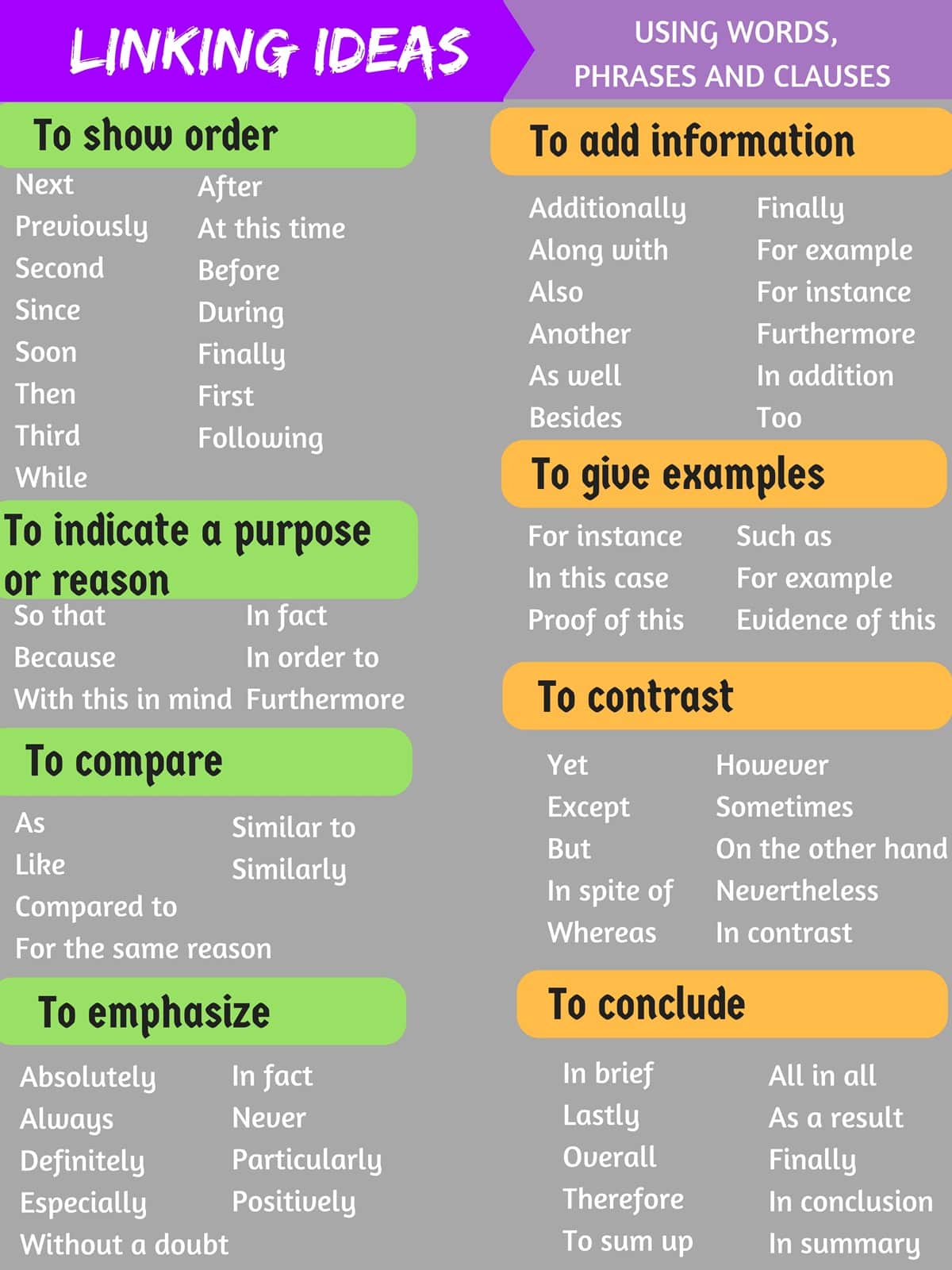
Linking WORDS


Linking Words and Phrases


Linking Words and Phrases


To Show Order


– After

– At this time

– Before

– During

– Finally

– First

– Following

– Next

– Previously

– Second

– Since

– Soon

– Then

– Third

– While


To Add Information


– Additionally

– Along with

– Also

– Another

– As well

– Besides

– Finally

– For example

– For instance

– Furthermore

In addition

Too


To Indicate a Purpose or Reason


– So that

– With this in mind

– Because

– In fact

– In order to

– Furthermore


To Give Examples


– Such as

– For example

– Evidence of this

– For instance

– In this case

– Proof of this


To Compare


– As

– Compared to

– Like

– For the same reason

– Similar to

– Similarly


To Contrast


– However

– Sometimes

– On the other hand

– Nevertheless

– In contrast

– Yet

– Except

– But

– In spite of

– Whereas


To Emphasize


– Absolutely

– Always

– Definitely

– Especially

– Without a doubt

– In fact

– Never

– Particularly

– Positively


To Conclude


– All in all

– As a result

– Finally

– In conclusion

– In summary

– In brief

– Lastly

– Overall

– Therefore

– To sum up


Linking Words and Phrases


Linking Words and Phrases